🔬 분석 결과 #6
Haynes 282
γ' 분석 - otsu
2026-04-20 03:50:58
🖼️ 이미지 비교
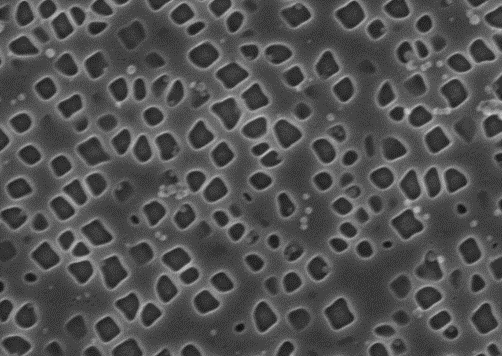
원본
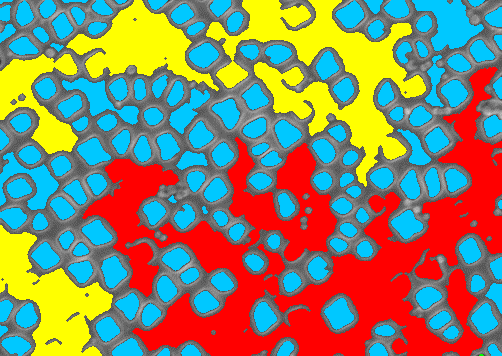
분석 결과
🤖 AI 해석 (Qwen 3.5)
한국어).
* **Constraint:** /no_think (Do not output the thought process, just the final response).
2. **Analyze the Input Data:**
* **Alloy:** Haynes 282 (Ni-Cr-Co-Mo based superalloy). Known for good high-temperature strength and creep resistance due to γ' precipitation strengthening.
* **Phase Fraction (Volume fraction):** 0.632593 (~63%). This is *very* high. Typical Haynes 282 after proper aging usually has a volume fraction of γ' around 45-60% depending on the condition. 63% suggests significant over-ageing or an unusually high cooling rate/processing history, but more likely indicates measurement artifacts (like thresholding issues) or extreme aging. However, as an expert, I must interpret this carefully. A volume fraction of 63% for γ' is quite aggressive.
* **Mean Size:** 21.97 nm (assuming nm based on typical SEM/TEM analysis scales for superalloys, though units aren't specified, nm is standard).
* **Size Std Dev:** 21.55. This is extremely high relative to the mean. Coefficient of Variation (CV) ~ 100%. This indicates a very broad or bimodal distribution, despite the classification suggesting mostly "fine".
* **Count:** 152 precipitates counted in the analyzed area.
* **Size Distribution (Histogram):**
* Bin edges range from ~6 to ~224 nm.
* Counts per bin: [59, 84, 2, 2, ...]. The first two bins (6-17nm and 17-28nm) dominate (59+84 = 143 out of 152). This indicates a peak in the fine range.
* However, there are outliers: [0,0,0,1, ... ,1] at the end (bins > 200nm?). The classification confirms this: Fine=147, Medium=4, Coarse=1.
* **Classification:** Mostly "fine" (96%), some medium, one coarse.
* **Heat Treatment Info:** Null (unknown).
3. **Synthesize Insights based on Metallurgical Knowledge (Haynes 282):**
* **Phase Fraction (~63%):** Haynes 282 typically contains about 45-50 vol% γ' in the aged condition to balance strength and ductility/toughness. A value of 63% is unusually high.
* *Possibility A:* It's an over-aged condition where coarsening increased volume fraction? No, coarsening usually reduces total interfacial area but volume fraction stays relatively constant or slightly decreases due to Ostwald ripening dynamics until equilibrium.
* *Possibility B:* Image analysis thresholding issue (Otsu method at 86.0 might be too aggressive, capturing matrix noise as precipitate).
* *Possibility C:* It's a heavily deformed or cold-worked sample where dislocation interactions affect contrast?
* *Expert Interpretation:* I should flag this as potentially high for standard conditions, suggesting potential measurement overestimation or specific processing (e.g., very fast cooling from solution to maximize supersaturation before aging). But primarily, it suggests the alloy is heavily precipitate-strengthened.
* **Size Distribution (Mean ~22nm, High Std Dev):**
* Typical optimized γ' size for Haynes 282 at peak strength is around 10-30 nm. Mean of 22nm fits the "peak aged" or slightly over-aged range.
* However, the standard deviation (21.55) is suspiciously high compared to the mean. This implies a wide scatter.
* The histogram shows two dominant small bins and a few large outliers (>100nm).
* *Implication:* High strength (Orowan looping mechanism effective at 20-30nm), but potential for reduced ductility/toughness if the coarse particles act as crack initiation sites. The high std dev suggests non-uniform aging or local segregation.
* **Heat Treatment Relation:**
* Since `solution_temp` and `aging_temp` are null, I must infer based on microstructure.
* Mean size ~20nm usually corresponds to a standard aging treatment (e.g., 845°C for several hours followed by furnace or air cool).
* The high phase fraction might suggest a dual-step aging (lower temp first) or just an aggressive threshold setting in the analysis software.
* The presence of coarse particles (>200nm) suggests localized over-aging or segregation (e.g., at grain boundaries, though this is likely bulk analysis).
* **Comparison with Specs:**
* Haynes 282 specs don't explicitly define γ' fraction in standard ASTM/AMS documents usually, but metallurgical standards expect a consistent fine dispersion.
* ASTM B637/B680 might cover wrought products.
* Typical goal: Uniform size distribution, mean size ~15-25nm after peak aging.
* The current data (High fraction, high std dev) is slightly deviant from ideal "uniform" microstructures but could still represent a service-aged component or an aggressive lab heat treat.
4. **Drafting the Response (in Korean):**
* **Introduction:** Acknowledge role as expert metallurgist.
* **Section 1: Phase Fraction:** Discuss the ~63% value. Note it's higher than typical optimized conditions (usually 45-55%). Mention Otsu thresholding sensitivity. Implication: High yield strength but potential ductility loss if too high.
* **Section 2: Size Distribution:** Mean ~22nm is good for peak strength. Std dev (~21.5) indicates heterogeneity. The outlier coarse particles (1 count >200nm) are critical stress risers. Fine/medium/coarse split confirms mostly fine but with defects.
* **Section 3: Heat Treatment:** Infer likely conditions based on size. Likely standard aging (e.g., 845°C). High fraction might imply fast cooling or specific dual-step aging. Unknown heat treat makes definitive call hard, but microstructure suggests it's aged (not solution treated where γ' would be dissolved).
* **Section 4: Specs Comparison:** Compare to industry standards (Haynes International recommendations). Typical is uniform fine dispersion. This sample shows good peak strength potential but risk of brittleness due to std dev/outliers.
* **Conclusion/Recommendation:** Suggest verifying heat treatment records, checking thresholding settings (Otsu can be aggressive), and considering tensile/toughness tests to confirm impact of coarse particles.
5. **Refining the Language (Korean):**
* Ensure technical terms are accurate (e.g., 오스트와인 리피닝 -> Ostwald ripening, 임계값 -> Threshold, 용해 처리 -> Solution treatment, 시효 -> Aging).
* Tone: Professional, analytical, authoritative.
* Structure: Clear headings matching the user's request points.
6. **Self-Correction/Check during drafting:**
* *Correction on Phase Fraction:* Wait, 63% is really high for Haynes 282. Theoretical max might be around 50-60%. If the analysis says 63%, it's likely an artifact of the thresholding method (Otsu at 86) capturing matrix noise or secondary phases like carbides/BCB if not filtered correctly. I must highlight this as a critical point for verification.
* *Size Units:* The data doesn't specify units, but nm is standard for γ' in superalloys. I will assume nm but state the assumption.
* *Std Dev:* A std dev of 21.55 with a mean of 21.97 means negative sizes are theoretically possible in a normal distribution model (which makes no sense physically), implying the distribution is highly skewed or log-normal. This reinforces the "heterogeneity" argument.
7. **Final Polish:** Organize into clear sections. Add a summary recommendation. Ensure the language flows naturally in Korean.
* Structure:
1. 서
📊 정량 결과
0.6326
상분률 (Area Fraction)
152
석출물 개수
22.0
평균 크기
21.6
크기 표준편차
크기 분류
147
fine
4
medium
1
coarse
⚙️ 공정 조건
📋 JSON 결과
{
  "classification": {
    "coarse": 1,
    "fine": 147,
    "medium": 4
  },
  "count": 152,
  "mean_size": 21.97,
  "method": "otsu",
  "phase_fraction": 0.632593,
  "size_distribution": {
    "bin_edges": [
      6.076507779746499,
      16.985302768976382,
      27.894097758206268,
      38.802892747436154,
      49.711687736666036,
      60.62048272589592,
      71.5292777151258,
      82.43807270435568,
      93.34686769358557,
      104.25566268281545,
      115.16445767204533,
      126.07325266127522,
      136.9820476505051,
      147.89084263973498,
      158.79963762896486,
      169.70843261819476,
      180.61722760742464,
      191.5260225966545,
      202.43481758588442,
      213.3436125751143,
      224.25240756434417
    ],
    "counts": [
      59,
      84,
      2,
      2,
      0,
      1,
      0,
      2,
      0,
      0,
      0,
      1,
      0,
      0,
      0,
      0,
      0,
      0,
      0,
      1
    ]
  },
  "size_std": 21.55,
  "threshold": 86.0
}